
A pirate ship ride is one of the most recognizable attractions in amusement parks. Its large boat-shaped gondola swings back and forth like a pendulum, creating a combination of height, acceleration, and brief weightless sensations.
Commercial pirate ship rides are available in different sizes, passenger capacities, and thrill levels. Choosing the right model depends on your available space, target visitors, expected traffic, local safety requirements, and long-term operating plan.
This guide explains the main pirate ship ride types, sizes, safety features, and buying factors to help amusement park owners and investors choose a suitable model.
Quick Answer: How Do You Choose a Pirate Ship Ride?
When choosing a pirate ship ride, focus on five factors:
- Available installation space
- Target rider group
- Required passenger capacity
- Desired thrill level
- Manufacturer quality and after-sales support
A larger ride is not automatically the better choice.
For medium-sized amusement parks, a 24-seat pirate ship can offer a good balance between capacity and space. Larger parks with higher visitor traffic may benefit from 36- or 40-seat models.
Buyers should also consider the complete project, including foundations, operating clearance, power supply, installation, maintenance, spare parts, and local inspection requirements.
What Is a Pirate Ship Ride?
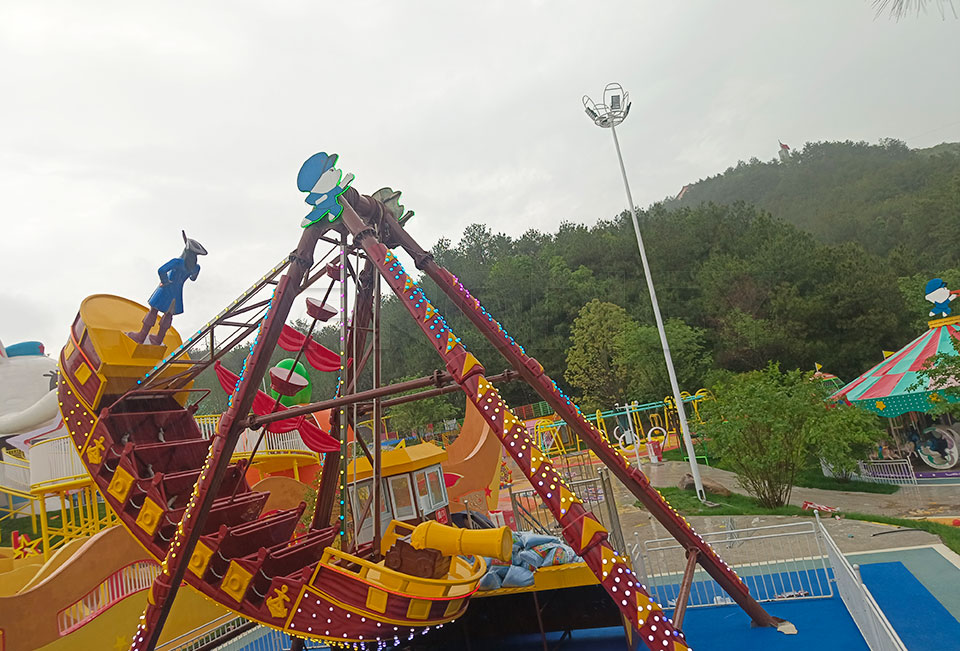

A pirate ship ride is a pendulum-style amusement ride with a boat-shaped passenger gondola suspended from a steel support structure.
During operation, the ship swings repeatedly forward and backward around a horizontal pivot. As the ride builds momentum, the ship rises higher on each side.
Passengers experience stronger acceleration near the bottom of the swing and a lighter sensation near the highest points.
Other common names include:
- Swinging ship ride
- Pirate boat ride
- Viking ship ride
- Swinging pirate ship
- Amusement park ship ride
Although these names are often used interchangeably, the actual specifications can vary significantly between models and manufacturers.s are often used interchangeably, specifications can vary substantially between manufacturers.
How Does a Pirate Ship Ride Work?
A commercial pirate ship normally includes:
- Steel support structure
- Swing arms
- Passenger gondola
- Drive system
- Braking system
- Passenger restraints
- Electrical control system
- Operator station
- Loading platform
- Safety fencing
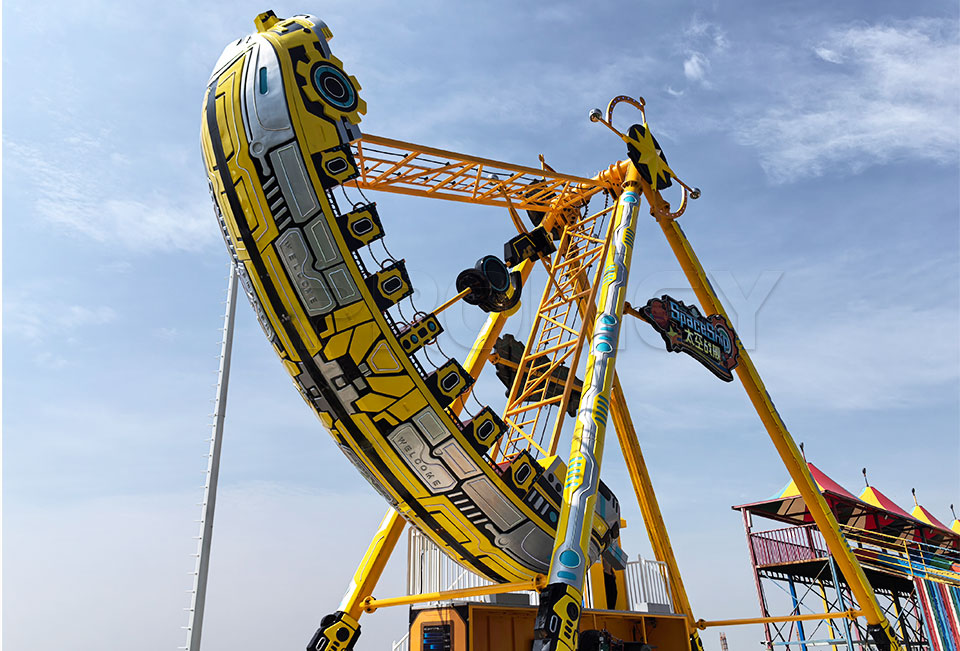
The drive system gradually increases the swinging motion until the ride reaches its intended operating angle.
At the end of the cycle, the braking and control systems reduce the movement until passengers can unload.
Different manufacturers may use different drive technologies. For buyers, the most important factors are whether the system is reliable, maintainable, properly documented, and supported with replacement parts.
Main Types of Pirate Ship Rides
Pirate ship rides can generally be divided according to passenger capacity, thrill level, and application.
1. Mini Pirate Ship Ride
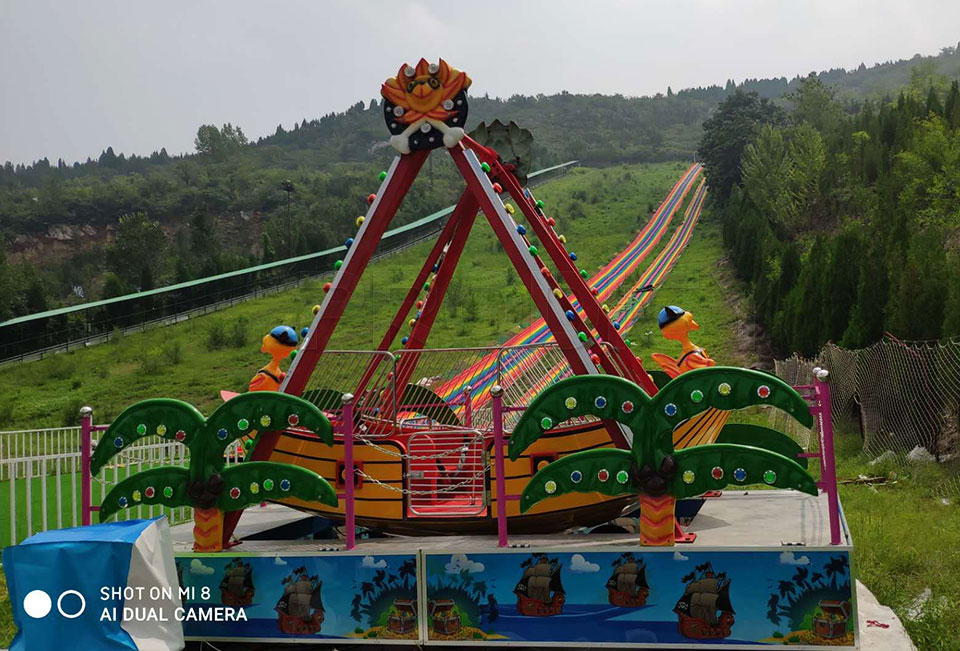

Mini pirate ships are mainly designed for children and smaller entertainment venues.
They usually offer:
- Lower passenger capacity
- Gentler movement
- Smaller footprint
- Lower ride height
Typical applications include children’s parks, malls, indoor entertainment centers, and small family entertainment centers.
2. Medium-Capacity Pirate Ship Ride
Medium-sized models provide a balance between passenger capacity, installation space, investment, and ride experience.
They are suitable for:
- Regional amusement parks
- Resorts
- Family entertainment parks
- Tourist attractions
- Medium-sized funfairs
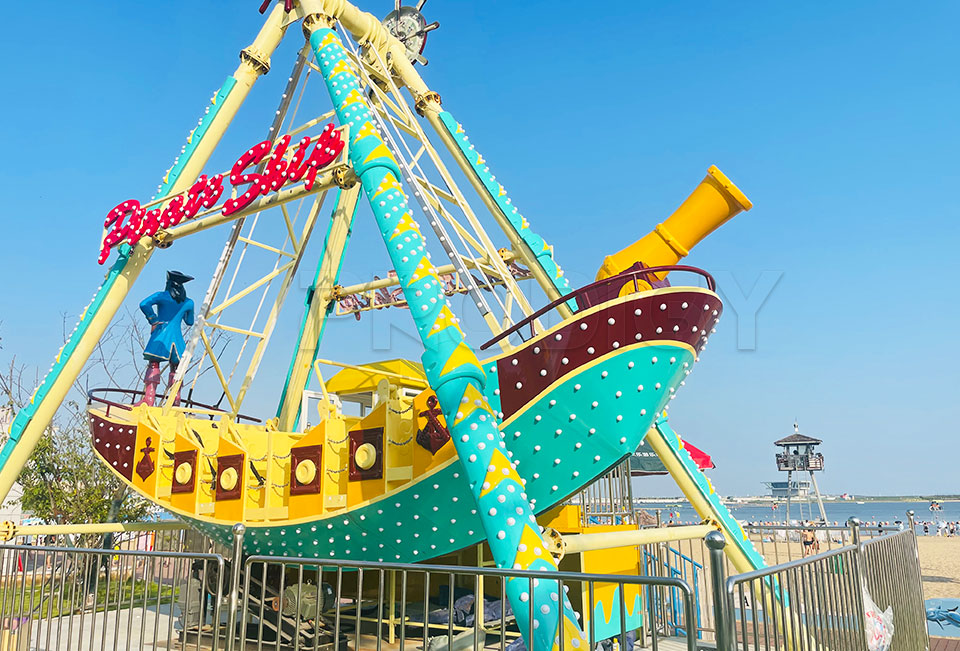
A 24-seat commercial pirate ship, for example, can provide strong commercial capacity without requiring the installation area of a larger ride.
3. Large Pirate Ship Ride
Large pirate ships are designed for higher visitor volumes and more prominent park locations.
They typically feature:
- Higher passenger capacity
- Larger supporting structures
- Larger operating areas
- Stronger visual impact
- Higher power and foundation requirements

They are more suitable for major amusement parks, theme parks, and high-traffic tourist attractions.
Pirate Ship Ride Sizes and Capacity
One of the most important buying questions is:
What size pirate ship ride should I choose?
The answer depends on your available space, visitor traffic, required throughput, and budget.
Prodigy Rides currently offers commercial pirate ship configurations including 24-, 36-, and 40-passenger models.
| Capacity | Suitable For | Main Advantage |
|---|---|---|
| 24 Seats | Medium parks, resorts, FECs | Good balance of capacity and space |
| 36 Seats | Medium to large parks | Higher passenger throughput |
| 40 Seats | Large parks and busy attractions | High capacity and strong visual impact |
Capacity should not be considered alone.
A larger ride may carry more passengers, but it also requires more space, stronger foundations, and higher installation costs.
For parks with moderate visitor traffic, a smaller model may provide better utilization and lower operating costs.
How Much Space Does a Pirate Ship Ride Need?
The physical size of the boat is not the same as the total installation area.
A complete pirate ship installation requires space for:
- The support structure
- Full swinging clearance
- Loading and unloading
- Safety fencing
- Queue area
- Operator access
- Maintenance access
- Electrical equipment
- Emergency access
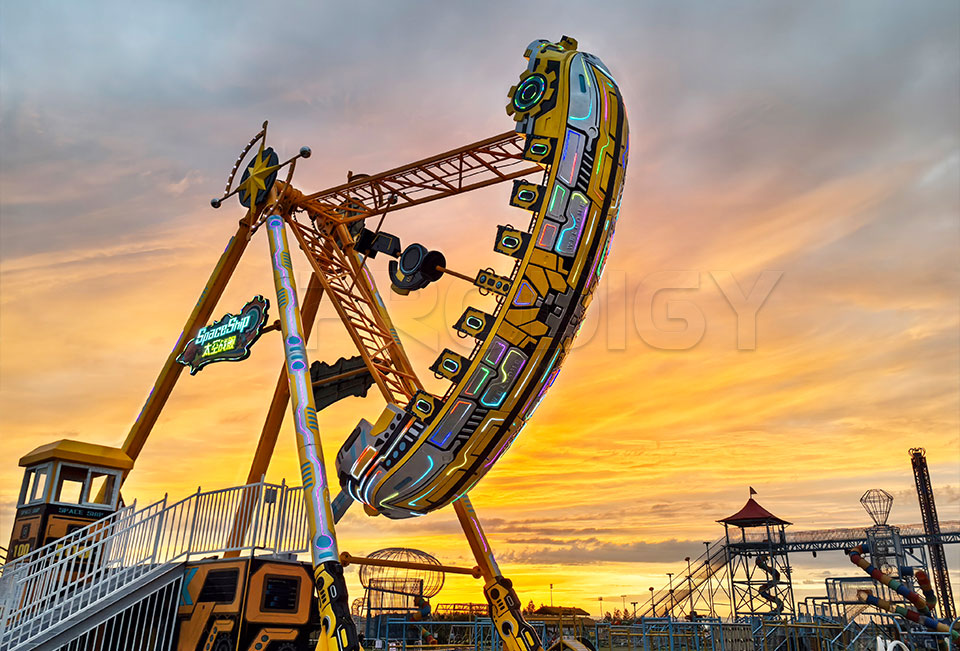
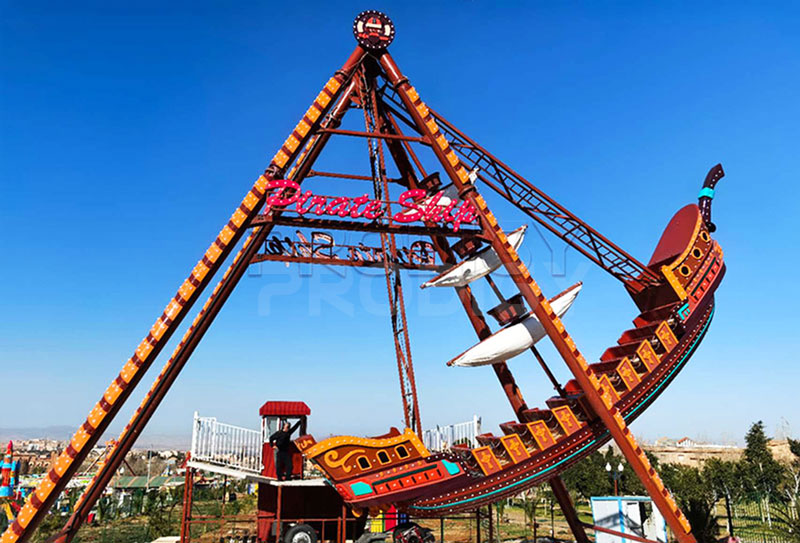
For example, Prodigy Rides’ current 24-seat pirate ship requires an installation area of approximately:
18 × 8.5 × 10 meters
The current 40-seat pirate ship requires approximately:
26 × 10 × 16.5 meters
This is why buyers should always request the complete installation drawing rather than looking only at the ride dimensions.
Before requesting a quotation, prepare basic site information such as:
- Available length and width
- Height restrictions
- Indoor or outdoor location
- Ground conditions
- Electrical supply
- Truck and crane access
This helps the manufacturer recommend a model that actually fits your project.
Is a Pirate Ship Ride Safe?
Pirate ship ride safety depends on the complete lifecycle of the equipment, including:
- Engineering
- Manufacturing
- Installation
- Operation
- Inspection
- Maintenance
Buyers should not judge ride safety based only on appearance.
Several key systems should be evaluated before purchasing.
Passenger Restraints
Passenger restraints help keep riders correctly positioned during operation.

When comparing rides, ask:
- What type of restraint is used?
- How does the locking system work?
- How is correct locking checked?
- What rider restrictions apply?
- How should restraints be inspected?
The manufacturer should provide clear operating and maintenance instructions.
Main Structure

The support structure, swing arms, passenger cabin, pivot assemblies, fasteners, and welded components must be manufactured according to the approved engineering design.
Buyers should ask about:
- Material specifications
- Welding quality
- Structural inspection
- Production quality control
- Corrosion protection
A decorative fiberglass ship may look attractive, but the steel structure underneath is much more important for long-term operation.
Drive, Braking, and Control Systems
The drive system controls the swinging movement, while the braking system manages deceleration and stopping.

The electrical control system may include:
- Operator controls
- Emergency stop
- Electrical protection
- Position monitoring
- Sensors
- Interlocks
The exact configuration varies by model.
When comparing manufacturers, ask them to explain how the system operates and how abnormal conditions are handled.
Inspection and Maintenance
Even a high-quality pirate ship requires regular inspection and preventive maintenance.
Typical inspection areas may include:
- Passenger restraints
- Bolts and fasteners
- Structural connections
- Bearings
- Pivot components
- Drive components
- Brake components
- Electrical equipment
- Sensors and switches
- Platform and fencing
Operators should follow the manufacturer’s maintenance manual and applicable local regulations.
It is also important to ask the supplier which spare parts should be kept in stock.
Reliable parts support can significantly reduce downtime during long-term operation.
How to Choose the Right Pirate Ship Ride
1. Identify Your Target Visitors
Start with your customer group.
Ask:
Who will use this ride most often?
A family-focused park may prefer a moderate thrill level with broad appeal.
A youth-oriented amusement park may prefer a larger or more intense model.
A children’s entertainment venue may need a smaller version.
The ride should match the overall attraction mix of the park.
2. Measure Your Site
Before choosing a model, confirm your available installation area.
Provide the manufacturer with:
- Site dimensions
- Height restrictions
- Nearby buildings
- Roads and entrances
- Existing attractions
- Ground conditions
A site drawing is even better.
This helps avoid selecting a ride that is too large for the available space.
3. Estimate Visitor Traffic
Consider both average traffic and peak periods.
If your park receives high visitor numbers during holidays and weekends, a larger-capacity model may help reduce queue times.
For smaller parks, oversized equipment may increase investment without producing enough additional revenue.
Capacity should match realistic demand.
4. Compare the Total Project Cost
Do not compare suppliers based only on the equipment price.
The complete investment may include:
- Ride equipment
- Packaging
- Shipping
- Customs duties
- Foundation work
- Crane rental
- Installation
- Electrical connection
- Testing
- Operator training
- Spare parts
- Inspection
For a more detailed cost breakdown, see the Prodigy Rides Pirate Ship Ride Price Guide.
5. Evaluate the Manufacturer
A pirate ship is a dynamic mechanical amusement ride, so supplier selection should include more than appearance and price.
Evaluate:
- Manufacturing history
- Engineering capability
- Factory quality control
- Similar completed projects
- Export experience
- Technical documentation
- Installation support
- Spare parts
- Warranty
- After-sales service
Ask the manufacturer to provide examples of similar pirate ship projects.
6. Confirm Local Requirements
Amusement ride regulations vary between countries and regions.
Before ordering, determine whether your project requires:
- Specific design standards
- Local certification
- Third-party inspection
- Technical documentation
- Electrical specifications
- Government approval
These requirements should be discussed before manufacturing begins.
7. Check Maintenance and Spare-Parts Support
Ask the manufacturer:
- What should be inspected daily?
- Which parts are wear parts?
- What spare parts are included?
- Are maintenance manuals supplied?
- Can replacement parts be shipped quickly?
- Is remote technical support available?
- Is on-site installation support available?
Long-term support is an important part of the total value of the ride.
Prodigy Rides Pirate Ship Options
Prodigy Rides has been manufacturing amusement equipment since 1999 and supplies commercial amusement rides for international projects.
Current pirate ship configurations include:
- 24 seats
- 36 seats
- 40 seats


The 24-seat model is suitable for projects looking for a balance between commercial capacity and installation space.
The 40-seat model is designed for larger parks and higher passenger demand.
For example:
24-Seat Pirate Ship
Installation area: approximately 18 × 8.5 × 10 m
40-Seat Pirate Ship
Installation area: approximately 26 × 10 × 16.5 m
Final dimensions, foundation requirements, and technical specifications should always be confirmed before site construction.
Frequently Asked Questions
What is a pirate ship ride?
A pirate ship ride is a pendulum-style amusement attraction in which passengers sit inside a boat-shaped gondola that swings back and forth.
What is another name for a pirate ship ride?
It may also be called a swinging ship ride, Viking ship ride, pirate boat ride, or swinging pirate ship.
How much space does a pirate ship ride need?
Space depends on the model and must include the complete swinging clearance. Prodigy’s current 24-seat model requires approximately 18 × 8.5 × 10 m, while the 40-seat model requires approximately 26 × 10 × 16.5 m.
Is a pirate ship ride suitable for family amusement parks?
Yes. Traditional pirate ship rides can work well in family amusement parks when the ride intensity and rider restrictions match the target audience.
How much does a pirate ship ride cost?
The price depends on passenger capacity, size, design, customization, shipping destination, installation requirements, and local compliance requirements.
What should I check before buying a pirate ship ride?
Check the capacity, installation area, restraints, drive and braking systems, electrical controls, foundation requirements, manufacturer experience, spare-parts support, documentation, and after-sales service.
Find the Right Pirate Ship Ride for Your Park
The best pirate ship ride is not necessarily the largest or cheapest model.
It should match your:
- Available space
- Target visitors
- Required capacity
- Project budget
- Local regulations
- Maintenance capability
- Long-term operating plan
Prodigy Rides offers 24-, 36-, and 40-seat commercial pirate ship rides for different amusement projects.
If you are planning a new amusement park or upgrading an existing attraction area, send us your destination country, available installation area, required passenger capacity, and project requirements.
Our team can help you select a suitable pirate ship configuration and provide technical specifications, layout information, customization options, and a project quotation.


 English
 Español
 Français
 العربية
 Русский
